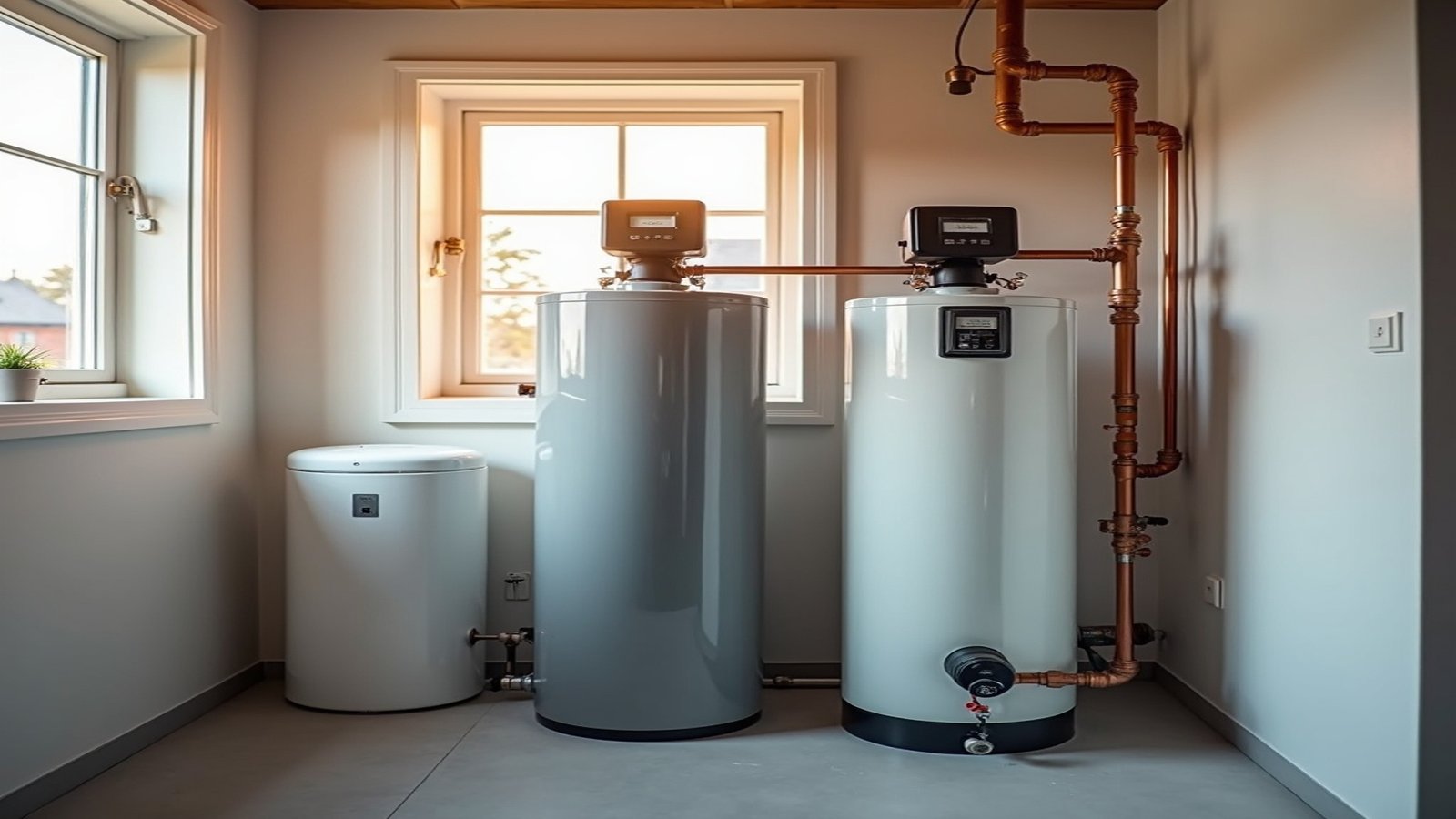
Modern whole-house water softener installed in a clean utility room

What Size Water Softener Do I Need?

Free calculator. 4 questions. Get a precise grain capacity recommendation and matched product pick.

Calculate Your Size

Quick Answer

For a family of 4 with average water hardness (10 GPG), you need a 32,000-grain water softener. The exact size depends on your water hardness, household size, and iron content. Use our calculator below to get a precise recommendation, or scan the quick reference chart. Most households fall between 32,000 and 48,000 grains. Oversizing wastes money and can cause bacteria growth, while undersizing burns through salt and wears out the resin faster.

Water Softener Sizing Calculator

Answer 4 questions to get a precise grain capacity recommendation and matched product pick.

1
2
3
4

Step 1 of 4: Household

How many people live in your household?

Common Recommendations

The six most common calculator outcomes, based on typical US households.

Family of 4, moderate hardness (10 GPG), budget-conscious

Fleck 5600SXT 48,000 Grain Water Softener

$700-$900|48K grains

The proven Fleck 5600 valve with 48K grains covers a family of 4 at moderate hardness with room to spare, all under $900.

Check Price →

Family of 4, moderate hardness (10 GPG), premium

SpringWell SS1 Salt-Based Water Softener

~$1,500|32K grains

Bluetooth monitoring, 10% crosslink resin, and a lifetime warranty make this the default upgrade for families who want set-and-forget quality.

Check Price →

Couple or single person, moderate hardness

Aquasure Harmony Series 32,000 Grain Water Softener

$500-$600|32K grains

Amazon's bestselling softener is the right size for 1-2 people and the lowest entry price for a digital metered system.

Check Price →

Large family (5-6 people), hard water (15+ GPG)

SpringWell SS4 Salt-Based Water Softener

~$1,800|48K grains

48K grains, 13 GPM flow rate, and premium resin handle large households with hard water without pressure drops.

Check Price →

Well water with high iron (3+ PPM)

SpringWell SS + WS Well Water Combo

~$3,200|48K grains

Dedicated iron/manganese pre-filter paired with a salt-based softener handles even the toughest well water.

Check Price →

Best option under $500

Aquasure Harmony Series 32,000 Grain Water Softener

$500-$600|32K grains

The Aquasure Harmony 32K is the most capable softener you can buy under $500, with digital metered control and fine mesh resin.

Check Price →

Quick Reference: Grain Capacity by Household Size

Find your household size on the left and water hardness across the top. The cell shows the recommended grain capacity tier.

HouseholdSoft
0-3 GPG
Moderate
7-10 GPG
Hard
11-14 GPG
Very Hard
15+ GPG
1-2 people24K24K-32K32K32K-48K
3-4 people24K-32K32K48K48K-64K
5-6 people32K48K64K64K-80K
7+ people48K64K80K80K+

Add 5 GPG per 1 PPM of iron for well water. These are baseline recommendations. Use the calculator above for a precise result that factors in iron content, water source, and budget.

Top Picks

9.2/10

~$1,500

SpringWell SS1 Salt-Based Water Softener

Best overall for most households. 32,000-grain capacity handles families of 4 with up to 15 GPG hardness. Bluetooth app monitoring, 10% crosslink resin resists chlorine, and a lifetime warranty make this the default premium pick.

32K grains11 GPM7 PPM iron
Pros:
  • + Bluetooth app for real-time monitoring and alerts
  • + 10% crosslink resin lasts 2x longer than standard 8%
  • + Lifetime warranty on tanks and valves
  • + Handles up to 7 PPM clear-water iron
Cons:
  • - Higher upfront cost than budget alternatives
  • - Requires professional plumbing for installation
Check Price at SpringWell
#2Budget Pick

Fleck 5600SXT 48,000 Grain Water Softener

Fleck / DuraWater

8.9/10

$700-$900

Fleck 5600SXT 48,000 Grain Water Softener

The undisputed budget champion. Proven Fleck 5600 valve with 5-year warranty, 10% crosslink resin, and metered demand-initiated regeneration. Reddit's #1 water softener recommendation for DIY installs.

48K grains12 GPM3 PPM iron
Pros:
  • + Best value per grain capacity in any size
  • + Proven Fleck 5600 valve with 5-year warranty
  • + Ships pre-loaded with resin, 1-2 hour DIY install
  • + Metered regeneration saves salt vs timed systems
Cons:
  • - No app or smart features
  • - Basic digital display, no WiFi connectivity
Check Price on Amazon
8.2/10

$500-$600

Aquasure Harmony Series 32,000 Grain Water Softener

Amazon's #1 bestselling water softener. Digital metered control, fine mesh resin for light iron removal, and a compact design make it the go-to entry-level softener for families on a budget.

32K grains11 GPM2 PPM iron
Pros:
  • + Amazon's #1 bestseller in the category
  • + Digital metered control head included
  • + Fine mesh resin handles light iron (up to 2 PPM)
  • + Compact design fits in tight utility closets
Cons:
  • - Lower iron handling than Fleck (2 PPM vs 3 PPM)
  • - Shorter warranty than premium brands
  • - Flow rate limited to 11 GPM
Check Price on Amazon

How We Score

Every water softener on this site is scored on a 0-10 scale across five weighted criteria. We do not accept payment from brands to adjust scores. The methodology is the same across every product and page.

25%

Capacity & Sizing

Grain capacity relative to household needs and hardness level

25%

Efficiency

Salt and water usage per regeneration cycle

20%

Durability

Resin quality, valve reliability, warranty length

20%

Value

Price relative to capacity and features

10%

Ease of Use

Installation difficulty, maintenance requirements, smart features

Frequently Asked Questions

What size water softener do I need for my house?

Multiply your household size by 75 gallons per person per day, then multiply by your water hardness in GPG, then multiply by 7 days. For a family of 4 with 10 GPG hardness: 4 x 75 x 10 x 7 = 21,000 grains per week. A 32,000-grain softener handles that with room to spare. Use our calculator above for a precise recommendation.

How do I find out how hard my water is?

Three options: check your annual water utility report (called a Consumer Confidence Report), request a free test kit from a softener company, or buy test strips for $10-15 at any hardware store. For the most accurate result, have your water tested by a certified lab, which typically costs $20-50.

What is the difference between GPG and PPM?

GPG (grains per gallon) and PPM (parts per million) both measure water hardness. 1 GPG equals 17.1 PPM. Most water softener manufacturers use GPG, while municipal water reports often use PPM. To convert PPM to GPG, divide by 17.1.

What happens if I buy a water softener that's too small?

An undersized softener regenerates too frequently, wasting salt and water while wearing out the resin bed faster. You may notice hard water between regeneration cycles, leading to scale buildup on fixtures and appliances. The unit's lifespan drops significantly because the resin degrades with each regeneration.

What happens if I buy a water softener that's too big?

An oversized softener regenerates too infrequently, which allows bacteria to grow in the stagnant resin bed. The salt water sitting in the brine tank can also develop mushing. Over time, the resin bed can develop channeling where water flows through the same paths, reducing effectiveness. The upfront cost is also higher than necessary.

How often should a water softener regenerate?

A properly sized water softener should regenerate every 7-10 days. More frequent regeneration (every 2-3 days) indicates the unit is undersized. Less frequent regeneration (every 2+ weeks) suggests it may be oversized. Modern metered systems regenerate based on actual water usage rather than a fixed timer.

Do I need a water softener with city water?

Probably. About 85% of US homes have hard water, and municipal treatment does not remove hardness minerals. Check your city's water report for hardness levels. If your water is above 7 GPG (120 PPM), a softener will protect your plumbing, appliances, and water heater from scale buildup.

What is the difference between a water softener and a water conditioner?

A water softener uses ion exchange to physically remove calcium and magnesium from water, replacing them with sodium. A water conditioner (salt-free system) changes the crystal structure of minerals so they don't stick to surfaces, but the minerals remain in the water. Softeners eliminate hardness completely; conditioners only reduce scale formation.

How much does it cost to operate a water softener per year?

A typical family of 4 spends $120-200 per year operating a water softener. That breaks down to roughly $70-120 for salt (about one 40-lb bag per month at $6-10 each), $20-40 for increased water usage during regeneration, and $10-30 for electricity. Salt-free conditioners cost almost nothing to operate.

Can I install a water softener myself?

Yes. Most whole-house water softeners can be installed in 2-4 hours with basic plumbing skills and tools. You need to cut into the main water line, install bypass valves, and run a drain line. The Fleck 5600SXT ships pre-loaded with resin and includes detailed instructions. If you're not comfortable with plumbing, professional installation typically costs $200-500.

How much salt does a water softener use?

A family of 4 with average hardness (10 GPG) uses roughly one 40-lb bag of salt per month. Higher hardness levels or larger households increase consumption. High-efficiency systems with upflow regeneration, like the SoftPro Elite, use 75% less salt than standard downflow designs. Expect to spend $6-10 per bag.

Does a water softener add sodium to my drinking water?

Yes, but the amount is minimal. At 10 GPG hardness, a softener adds about 30 mg of sodium per 8-oz glass. For comparison, a slice of white bread has about 150 mg. If sodium is a concern, you can use potassium chloride pellets instead (about 4x the cost) or install a reverse osmosis filter at your kitchen sink for drinking water.

Are water softeners banned anywhere?

Some areas restrict or ban salt-based water softeners due to the brine discharge during regeneration. Restrictions exist in parts of California, Michigan, Connecticut, and Texas. Check your local regulations before purchasing. Salt-free conditioners are legal everywhere since they produce no brine discharge.

What size water softener do I need for well water?

Well water requires extra capacity because iron acts as additional hardness. Add 5 GPG for each 1 PPM of iron to your water hardness before sizing. For example, if your well has 15 GPG hardness and 3 PPM iron, your effective hardness is 15 + (3 x 5) = 30 GPG. A well water filter paired with a softener, like the SpringWell SS+WS combo, is the most effective solution for high-iron wells.

How long does a water softener last?

A well-maintained water softener lasts 10-15 years. The resin bed typically needs replacement every 10-20 years depending on chlorine exposure and iron content. Control valves may need servicing around year 10. Premium resins (10% crosslink) last roughly twice as long as standard 8% crosslink resin. Regular salt refills and occasional brine tank cleaning are the primary maintenance tasks.